
Licensed, Bonded, and Insured: What That's Worth in Washington
A Washington general contractor's bond is $30,000, shared among everyone with a claim. A midrange Seattle bathroom costs $36,146. Here is what the bond, the insurance, and the state's new recovery fund cover, and the protections that do more.
It's on the side of the truck, the bottom of the estimate, and the footer of the website. Licensed, bonded, and insured. Three words that are supposed to settle your nerves before you hand a stranger the keys to your kitchen.
Most homeowners take the phrase to mean something like "if this goes badly, I'm covered." That's about half right, and the wrong half can cost you a lot.
I run a company that publishes Washington contractors' state records, so I've read the statute behind those three words more times than I'd recommend. This post walks through what each one means here, with the dollar amounts. I'm not a lawyer and this isn't legal advice. The laws are linked at the bottom, and if you're in a dispute you should talk to an attorney.
"Licensed" mostly means registered
Washington doesn't license general contractors the way it licenses electricians. It registers them.
To register, a contractor needs a state business number, a surety bond, liability insurance, and a fee of about $150. That's the list. No exam appears anywhere in it, and neither does an experience requirement or an inspection of past work. The Department of Labor & Industries frames registration around the bond and the insurance, which exist to protect the public. Nothing in the requirements tests competence.
Certain trades are different. Electricians and plumbers hold individual licenses that involve training hours and exams, under separate laws. So a licensed electrician has passed a test. A registered general contractor has filled out a form and bought a bond.
That's worth knowing, because the form and the bond still matter. They're your leverage if something goes wrong. An unregistered contractor has neither, and the state finds plenty of them: more than 1,000 infractions for unregistered contracting in fiscal year 2025, and 41 unregistered contractors or tradespeople across about 350 job sites in a single two-day sweep in October 2025.
"Bonded" means $30,000, shared
A general contractor in Washington must carry a $30,000 bond. A specialty contractor, someone registered for one trade like painting or roofing, must carry $15,000.
Those numbers are recent. Until July 1, 2024, they were $12,000 and $6,000, and according to testimony on the bill they hadn't been raised in more than twenty years. (Contractors already registered kept their old bonds until their next renewal.) The legislature raised them in 2023 by votes of 97 to 0 and 49 to 0, which tells you how overdue it was.
Thirty thousand dollars sounds like real money until you put it next to what projects cost.
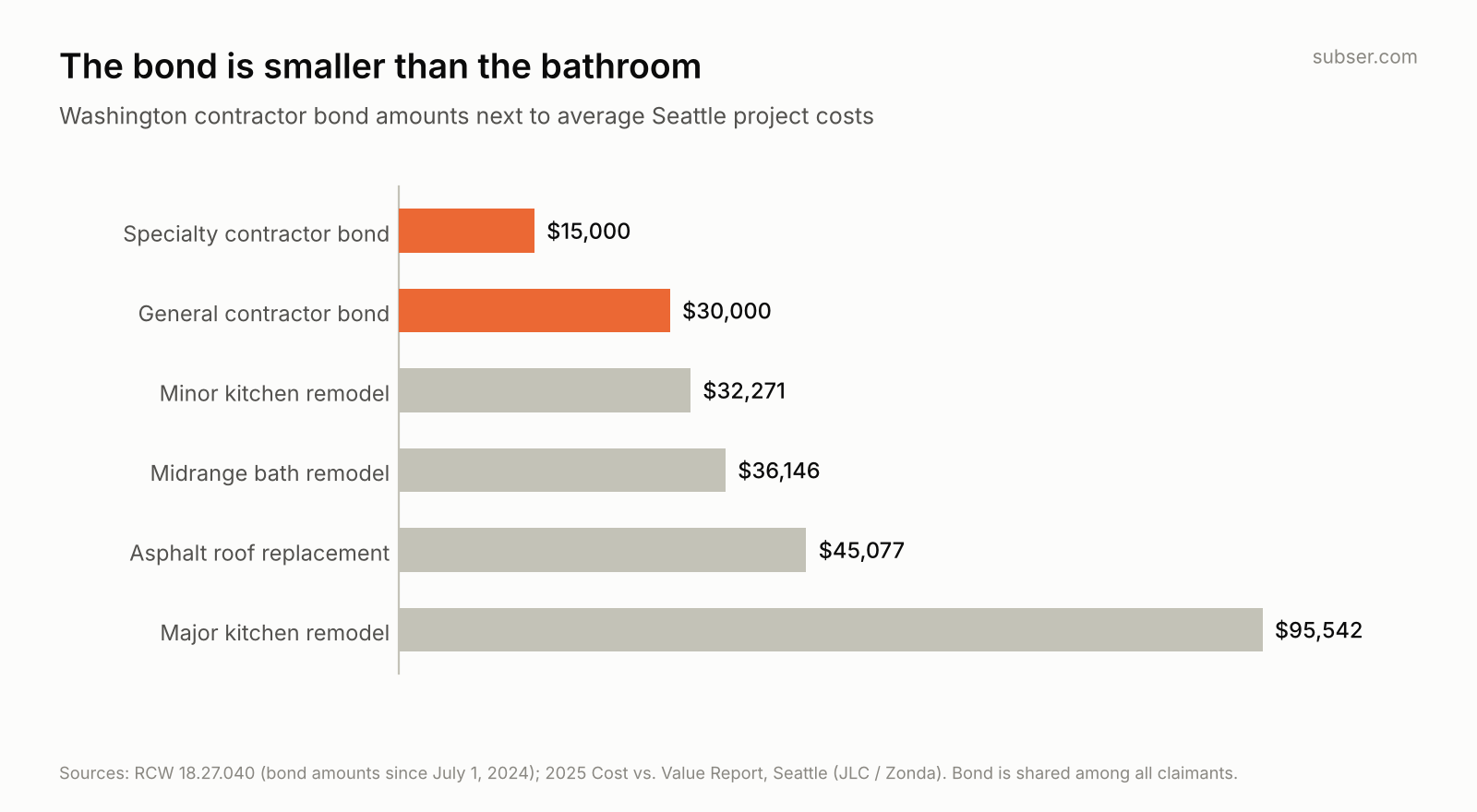
According to the 2025 Cost vs. Value Report, a midrange bathroom remodel in Seattle runs $36,146. A minor kitchen remodel is $32,271. A new asphalt roof, $45,077. A midrange major kitchen remodel, $95,542.
The general contractor's entire bond is smaller than one bathroom, and it covers less than a third of the kitchen.
And you don't get the entire bond. Four things in the statute shrink it further.
It's one pot for everyone. The bond covers every claim against that contractor: other homeowners, unpaid employees, suppliers, subcontractors, and the state for unpaid taxes. On residential jobs of $1,000 or more, the law requires contractors to tell you this in writing, in a notice that says the bond is not for your exclusive use and might not be enough to cover a claim.
There's a line, and you're second. When claims exceed the bond, the statute sets the order. Employees owed wages come first. Then claims for breach of contract by a party to the contract, which is where you are. Then subcontractors and suppliers, then state taxes, then court costs and attorney fees.
Half is fenced off for homeowners. The law says everyone who isn't a "residential homeowner" can take no more than half the bond combined. That leaves at least $15,000 of a general contractor's bond, or $7,500 of a specialty contractor's, that only homeowner claims can reach. Collectively. If three homeowners have claims, they share it. And the term is narrow: it means an individual who lives, or will live, in the single-family home. Landlords and investors should ask a lawyer where they stand.
You have to sue. You can't file a claim with the bonding company the way you would with your car insurer. You file a lawsuit in superior court, name the bonding company as a party, and serve the papers on L&I with a fee. Small claims court can't reach the bond. Residential homeowners have two years from when the work was substantially finished or abandoned, whichever came first.
One thing does work in your favor. When a judgment eats into the bond, the contractor's registration is suspended automatically until the bond is made whole. A contractor who wants to keep working has a strong reason to settle with you before it gets that far.
"Insured" covers accidents, not bad work
The state requires contractors to carry liability insurance. L&I describes the minimum as $200,000 in public liability and $50,000 in property damage, or a $250,000 combined policy.
This is the coverage for when something gets broken or someone gets hurt. The ladder goes through the window. A pipe is cut and the downstairs floods. A delivery driver trips over the lumber.
What it generally isn't is a warranty. If the tile is crooked, the deck is out of level, or the contractor stops showing up with the job half done, liability insurance usually isn't the answer. Whether a particular policy responds to defective workmanship depends on the policy, and many exclude it. The bond is the part meant for broken promises, and we just saw how big the bond is.
Insurance can also lapse between the estimate and the first day of work. When it does, the registration suspends automatically. Which brings us to the most useful two minutes in this post.
Check the record, and check it again
L&I runs a free lookup called Verify a Contractor. Type in a name or registration number and you'll see whether the registration is active, whether the contractor has a workers' comp account, any infractions and safety citations, and whether anyone has filed a lawsuit against the bond.
That last item is the one to look at. A lawsuit against the bond means a previous customer, employee, or supplier went to superior court to get paid. One old suit that was resolved may mean nothing. Several recent ones means the $30,000 pot may already be spoken for.
We show the same state record in the Subser directory, for the same reason: it's public information that almost nobody looks at.
Check when you're collecting bids. Then check again the week you sign. When we analyzed the state's data in October, about 9,300 construction contractor registrations were sitting in suspended status. Most of those are probably paperwork lapses, but a contractor who is suspended on the day they start your job is, legally, not registered.
Washington's new recovery fund
Here's something that changed this year, and most homeowners haven't heard about it.
Since July 1, 2026, Washington's Homeowner Recovery Program has been open for claims. If you win a court judgment against a registered contractor and can't collect it, the program can pay up to $25,000.
The conditions, from L&I's description:
You must own and live in the home. It has to be a single-family house or a building with four or fewer units. Condominiums are excluded.
The contractor must be registered with L&I.
You need a final judgment from superior court, entered after July 1, 2026.
You apply within 90 days after the court case ends.
If you're approved, you sign your rights in the judgment over to L&I before you're paid.
The statute adds three more things. You have to go after the bond first. The program pays actual damages only, not attorney fees or court costs. And payments are discretionary.
And the caveats matter. Payment depends on available funds. L&I's page says so directly and describes a waitlist when money is short. The program is funded by contractor fines, and an L&I report showed about $748,000 deposited as of December 2025. At $25,000 a claim, that's roughly thirty maximum payouts, and the statute lets the program spend only 80% of its balance in a year, so closer to two dozen. I'd expect the fund to grow, but nobody should plan a remodel around it.
It's still a real improvement. A few states have had funds like this for years; Maryland's and Virginia's each pay up to $30,000 per claim. Washington had no equivalent for general contracting. Now a homeowner with a judgment against a registered contractor who has vanished has a second place to turn after the bond.
Notice the word that keeps coming up: registered. The bond exists only if the contractor is registered. The recovery fund pays only on judgments against registered contractors. Hire someone unregistered and you've given up both, usually to save a few hundred dollars.
The protections that do more than the bond
The bond is a backstop, and a thin one. These are the things that keep you from needing it.
Get the disclosure statement. On residential jobs of $1,000 or more, the contractor is required to give you a written notice before work starts. It explains the bond, your right to ask for lien releases, and the risk I'll describe next. A contractor who hands it over without being asked knows the rules. One who's never heard of it is telling you something too.
Ask for lien releases. This is the one that surprises people. If your contractor doesn't pay the lumber yard or the plumbing sub, those businesses can file a lien against your house. Washington gives some protection if you live in the single-family home being remodeled: a supplier's or subcontractor's lien can generally reach only what you still owed the contractor when you received their written lien notice. So watch for those notices, and don't ignore one. On new construction and other kinds of property, you can end up paying for the same materials twice. A lien release is a signed statement that the supplier or sub has been paid. Ask for them with each progress payment.
Pay as work gets done. L&I's advice to homeowners is blunt: avoid large down payments, don't pay cash, and pay as the work is completed. The less of your money that's ahead of the work, the less there is to chase.
Use a credit card for the deposit, if the contractor takes them. Card issuers have a dispute process for charges when the goods or services weren't delivered as agreed. It comes with conditions and deadlines, and you're expected to try to sort it out with the contractor first, so read your issuer's rules. It's still faster than superior court.
Know one more rule. In Washington, a contractor who wasn't registered when the contract was made can't sue to collect on it. That's the state's stick. It doesn't make hiring an unregistered contractor a good idea, for all the reasons above, but it does explain why legitimate contractors guard their registration.
A word to the contractors reading this
If you're registered, bonded, and insured, and you keep it that way without lapses, you're doing something a meaningful share of the market doesn't. I'd argue "licensed, bonded, and insured" undersells it, because every truck says that.
What would stand out is being specific. Your registration number, where it can be checked. How long you've held it without a suspension. Zero lawsuits against your bond, if that's true, and it's on the public record for anyone to confirm. A stack of lien releases you hand over without being asked.
A homeowner who has read this far now knows the bond won't save them. They're looking for a contractor who makes it obvious the bond will never come up.
Sources
Statutes are cited as they read in October 2026. Dollar amounts and deadlines change; confirm them on the linked pages before relying on them.
- RCW 18.27.040, bond amounts, claims, priority and time limits
- Second Substitute House Bill 1534, Laws of 2023, chapter 213 and House bill report
- L&I, Register as a contractor (requirements, insurance minimums as L&I describes them, fee) and RCW 18.27.050 (insurance requirement and automatic suspension)
- L&I, Verify a contractor, tradesperson or business
- L&I, Filing a lawsuit against a contractor's bond
- L&I, Homeowner Recovery Fund and RCW 18.27.410
- L&I, 2025 Homeowner Recovery Program Report
- L&I, Underground Economy Benchmark Report, fiscal year 2025
- L&I news release on the October 2025 compliance sweep
- RCW 18.27.114, disclosure statement and RCW 60.04.031, lien notices and owner-occupied remodels
- RCW 18.27.080, registration required to sue
- L&I, Hire Smart worksheet
- 2025 Cost vs. Value Report, Seattle (Journal of Light Construction / Zonda)
- Maryland Home Improvement Commission, Guaranty Fund
- Virginia DPOR, Contractor Transaction Recovery Fund
- Subser analysis of L&I Contractor License Data, queried October 7, 2026