The Slowest Part of the Job Is Getting Paid
A repair business has a median of 18 days of cash on hand. Here is what the data says about slow payment, the famous statistic you should stop quoting, the real cost of taking a card, and the Washington rules that decide whether you can collect at all.
A water heater swap takes about three hours. Collecting the $2,500 for it can take three weeks.
Nobody plans it that way. Here's an invented but familiar version. The job ends at 4:40 on a Thursday, the homeowner is on a work call, and you say "I'll send the invoice over." Friday is a full day. The invoice goes out Monday night. The homeowner opens it Wednesday, means to deal with it, and remembers the following Tuesday when your reminder shows up. The check is mailed. It arrives. It sits on the dash until you're near the bank.
Every step in that story is reasonable, and together they add up to nineteen days.
This post is about that gap: how much it costs, what the research says and doesn't say, and a few Washington rules that decide whether you get paid at all when things go wrong.
Eighteen days
The best independent data on small business cash comes from the JPMorgan Chase Institute, which studied the bank accounts of 597,000 small businesses and calculated what it called cash buffer days: how long a business could keep paying its bills if money stopped coming in.
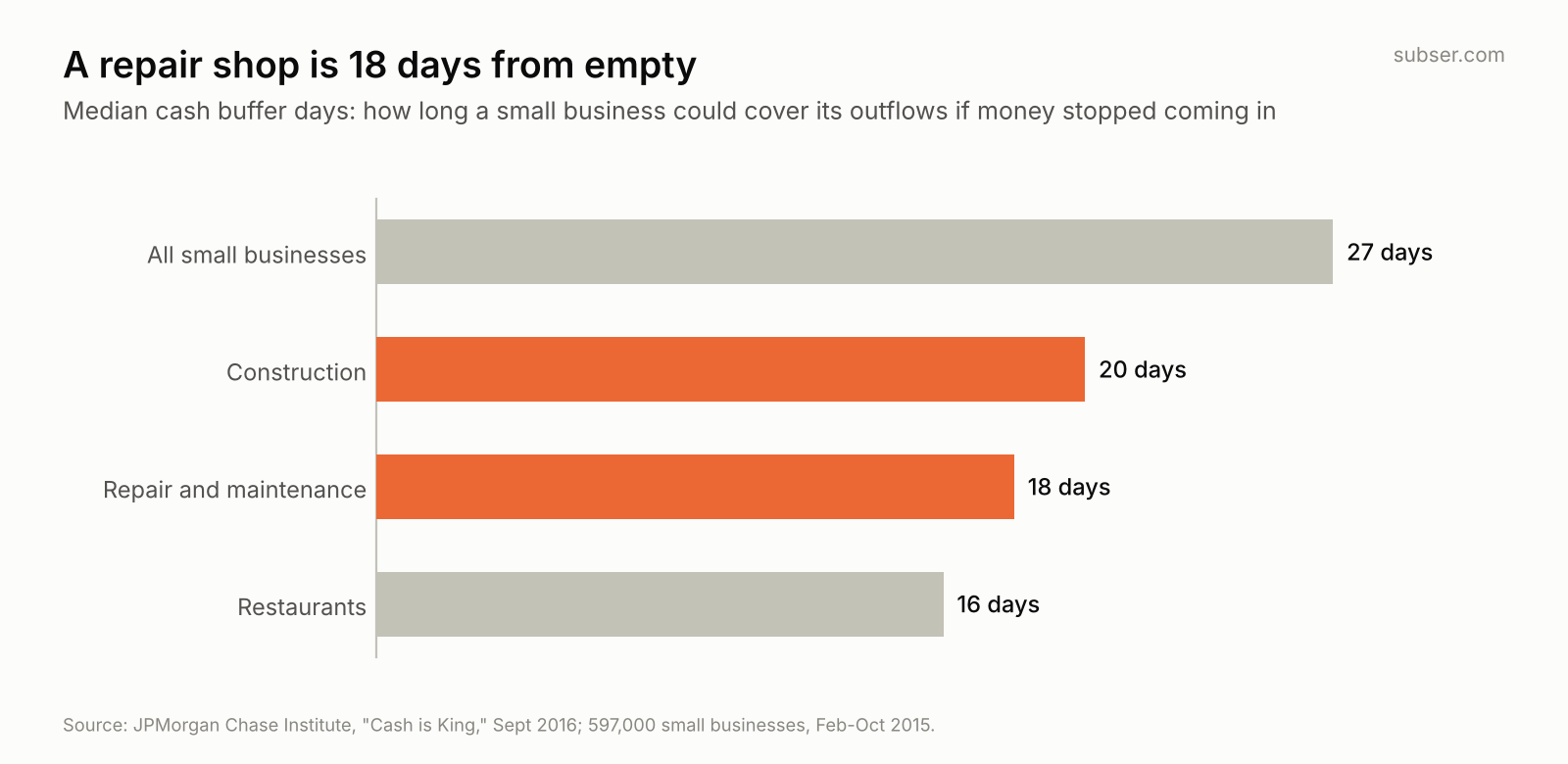
The median small business had 27 days. Construction had 20. Repair and maintenance had 18. For comparison, restaurants, the industry everyone thinks of as living on the edge, had 16.
The study is from 2016, using 2015 data, so it's getting old. I use it anyway because it's built from real bank balances, not a survey, and nobody has published anything better. A 2020 follow-up from the same institute put the median Seattle small business at 18 days.
Hold that number, 18 days, next to the nineteen-day story above. A typical repair business has enough cash to survive roughly one slow-paying customer's worth of delay. It's not short on work or on profit. It's short on days.
A statistic you should stop quoting
You have seen this one: "82% of small businesses fail because of cash flow problems." It's in pitch decks, bank brochures, and about ten thousand blog posts, including some from software companies like mine.
I tried to find where it comes from. Secondary sources attribute it to "a study by Jessie Hagen," with no year, no link, and no document. SCORE, the small business mentoring nonprofit, links it to a 2017 Business Insider infographic. I could not find the study. As far as I can tell nobody quoting it has read it, because nobody links to it. Even the original wording, as it's passed around, says poor cash flow management "contributed to" failures, which is a much weaker claim than "caused."
So I'm not going to use it. A number nobody can trace is just something people say.
Here is what holds up. In the Federal Reserve's 2024 Small Business Credit Survey of 7,653 employer firms, 56% said paying operating expenses was a financial challenge and 51% cited uneven cash flow. In a 2025 Intuit QuickBooks survey of 2,487 small businesses, 56% said they were owed money on unpaid invoices, about $17,500 on average, and 47% had invoices more than 30 days overdue. QuickBooks sells invoicing software, so apply the usual discount, but the Fed doesn't.
And for the grim baseline: of all US business establishments that opened in 2014, the Bureau of Labor Statistics found about half were gone five years later. Cash is surely part of that story. How big a part, nobody has measured as cleanly as "82%" pretends.
The commercial numbers don't describe you
If you search for data on contractors getting paid late, you'll find alarming figures. An average payment cycle of 57 days for subcontractors. Eighty-two percent of contractors waiting more than 30 days. A claimed $280 billion annual cost of slow payment.
Those come from commercial construction: general contractors and subs on developer-financed projects with pay applications, retainage, and lenders releasing draws. They're published by companies that sell payment software or financing to that world. They may be accurate for a framing sub on an apartment building. They don't describe a plumber billing a homeowner.
I could not find a rigorous days-to-pay figure for small residential contractors. If someone quotes you one, ask where it's from.
What I can do is reason about it. Residential work has a structural advantage the commercial side would envy: your customer is standing in the kitchen. There is no accounts payable department, no pay-when-paid clause, no 45-day cycle. Payment is usually due on completion. Which means that when a residential contractor waits three weeks, most of the wait is typically not the customer refusing to pay. Go back to the Thursday water heater. The homeowner sat on it for about a week. Most of the rest was the invoice not existing yet, the reminder not being sent, and the check riding around in a truck.
That is good news, in a backhanded way. The biggest part of the delay is the part you control.
What a card really costs
Contractors tend to have a strong opinion about card fees, and the opinion is that they're robbery.
Here's the math on that $2,500 invoice, using Stripe's published rates. An online card payment costs 2.9% plus 30 cents: $72.80. A bank transfer (ACH) costs 0.8% with a $5 cap: $5.00. A check costs nothing but a trip to the bank.
Is $72.80 a lot? Washington law offers a yardstick. Where no rate has been agreed in writing, the state's default interest rate on money owed is 12% a year. I'm borrowing that as a measuring stick, not suggesting you can tack 12% onto an invoice. At 12%, $2,500 earns about 82 cents a day. So the card fee is worth about three months of interest.
Put plainly: if a customer would otherwise pay you by check within three months, and you can afford to wait, the check is cheaper. This is the strongest argument against everything payment companies tell you, and it's correct as far as it goes.
It doesn't go far enough, because of the phrase "if you can afford to wait." With 18 days of buffer, the question was never the interest rate. The question is whether the supplier bill and Friday's payroll clear. Nobody goes under from paying 2.9%. They go under when the account is empty on the day payroll is due.
The move that makes sense on the numbers is the one in the middle, and most contractors skip it. ACH on a $2,500 invoice costs $5. That's cheaper than the gas to drive to the bank. Offer the bank transfer first and the card second, and send both as a link the customer can tap while you're still packing up.
A note on passing the fee along. Visa's rules allow surcharging on credit cards only, never debit or prepaid, capped at the lower of your actual cost or 3%, with advance notice to your processor, a posted disclosure, and a separate line on the receipt. Check with your processor before you add a line item, because the card networks are stricter than most people assume.
Checks aren't dead, they're getting bigger
Checks paid in the US, by consumers, businesses, and governments combined, fell from 17 billion in 2015 to 9.2 billion in 2024, according to the Federal Reserve Payments Study. In the Atlanta Fed's consumer survey, checks are about 2% of payments by count.
But the average check went from $1,533 to $2,653 over the same years. My read: people stopped writing checks for groceries and kept writing them for big, occasional bills. Like a contractor's invoice. A third of consumers in the Atlanta Fed's most recent survey had written one in the past 30 days.
Meanwhile, Jobber reported that digital payments passed 51% of the transactions it processed in early 2026. That's one vendor's customers, but it suggests the halfway point is about now.
So your customers are split. Some will always reach for the checkbook, and that's fine. The point of offering a payment link is not to convert them. It's to stop making the other half wait for a stamp.
The Washington rules that decide whether you can collect
Everything above is about getting paid faster by people who intend to pay. This section is about the ones who don't. I'm not a lawyer and this is not legal advice. It's a reading of the statutes, which are linked below, and you should talk to an attorney about your own situation.
The one-page form that protects your lien. On residential jobs of $1,000 or more, Washington requires contractors to give the customer a disclosure statement before work starts. The customer signs it and you keep it for three years. L&I publishes a model form. Skip it, and under the statute you cannot bring a lien claim on that job. It's an easy form to miss, and it takes about a minute to hand over.
Ninety days. A construction lien has to be recorded within 90 days of your last work on the job, and a lawsuit to enforce it filed within eight months of recording and then served on the owner within 90 days of filing. The first clock starts when you stop working. If you spend ten weeks politely waiting on a customer who keeps promising, you have less than three weeks left.
Your LLC can sue for less than you can. Washington small claims court handles claims up to $10,000 if you're a "natural person." For everyone else, including an LLC or corporation, the limit is $5,000. So the sole proprietor down the street can take a $9,000 unpaid invoice to small claims, and your LLC can't. I'm not arguing against forming an LLC, since there are good reasons to have one. Just know which court you're headed for.
You have to be registered to sue at all. A contractor who wasn't registered when the contract was made can't bring a lawsuit to collect on it. If your registration lapsed for two weeks in the spring because the insurance payment bounced, contracts you signed in those two weeks are exposed.
Deposits. I looked for a statutory cap on deposits for general contracting work in Washington and didn't find one. The state's consumer guidance does tell homeowners to be wary of large down payments and to pay as work is completed. Translation: a modest deposit plus progress payments at clear milestones will get less pushback than half up front, and it means you're never more than one milestone behind.
What I'd change on Monday
Send the invoice before you leave the driveway. Of everything in this post, this matters most, and it costs nothing. Most of the self-inflicted days in the water heater story trace back to "I'll send it over."
Put a way to pay inside the invoice. A link with bank transfer and card options. The customer who was going to write a check still will.
Offer bank transfer first. Five dollars beats $72.80.
Take a deposit on anything with materials, and tie the rest to milestones.
Hand over the disclosure statement on every residential job over $1,000, and keep the signed copy.
Put the 90-day lien deadline on your calendar the day a job closes with a balance. You'll almost never need it. The one time you do, you won't have time to look it up.
Invoicing from the job site and getting paid by link are both in Subser, and we pass Stripe's fees through without adding a markup. But none of the six things above needs our software or anyone's. They need to happen on Thursday at 4:40 instead of Monday night.
Sources
- JPMorgan Chase Institute, "Cash is King: Flows, Balances, and Buffer Days," September 2016
- JPMorgan Chase Institute, small business cash liquidity in 25 metro areas, April 2020
- Federal Reserve Banks, 2025 Report on Employer Firms, Small Business Credit Survey
- Intuit QuickBooks, Small Business Late Payments Report 2025 (vendor survey)
- SCORE on the "82%" statistic and an example of the usual attribution
- Bureau of Labor Statistics, survival of establishments by opening year
- Rabbet, 2024 Construction Payments Report and its press release (commercial construction; payment software vendor)
- PYMNTS on commercial subcontractor payment cycles
- Stripe pricing
- RCW 19.52.010, default interest rate
- Visa, merchant surcharging considerations and requirements
- Federal Reserve Payments Study, 2015 to 2024
- Federal Reserve Bank of Atlanta, Survey and Diary of Consumer Payment Choice and 2025 results report
- Jobber Home Service Economic Report, May 2026 (vendor data)
- RCW 18.27.114, disclosure statement and L&I model disclosure form F625-030-000
- Chapter 60.04 RCW, construction liens
- RCW 12.40.010, small claims jurisdiction
- RCW 18.27.080, registration required to sue
- L&I, Hire Smart: step by step