
Private Equity Is Buying the Plumber Down the Street. What If You're Not Selling?
Investors have bought hundreds of HVAC, plumbing and electrical companies, including several in Washington. Here is what the deal data shows, what they're paying for, and what it means for the shop that plans to stay independent.
In February, Blackstone agreed to buy a company that fixes furnaces.
Blackstone manages more than a trillion dollars. It owns office towers, data centers, and a meaningful slice of the world's warehouses. The company it agreed to buy, Champions Group, sends technicians to people's houses to repair air conditioners and unclog drains. Champions has more than 1,800 field technicians and about 150,000 customers on membership plans. The companies didn't disclose terms; Bloomberg and others reported a price of around $2.5 billion. The deal was expected to close in the first half of this year.
Two Seattle companies are among Champions Group's brands. Seatown Electric, Plumbing, Heating & Air was bought in 2023 by Service Champions, a sister brand under the same owner, when Seatown had about 200 employees and more than $60 million in revenue. Bee's Plumbing, founded in Seattle in 2017, followed in June 2025. Champions called it the company's second acquisition in the Seattle area.
So the van that pulls up to fix a water heater in Ballard may belong, a few layers up, to one of the largest investment firms on earth. Nothing on the van says so.
If you run an independent shop, you have probably had two reactions to news like this. One is "good for them." The other is a quieter question about what it means for you. This post is about the second one.
How much has been bought
The honest answer is that nobody has a complete count, and anyone who gives you a single tidy number is rounding off a lot of uncertainty.
The most cited figure comes from The Wall Street Journal, which reported in October 2024 that private equity firms had bought nearly 800 HVAC, plumbing, and electrical companies since 2022, based on PitchBook data. The Journal noted that PitchBook mostly tracks larger deals, so the real number is higher.
PitchBook's own analysts published a narrower series in June 2025, covering just HVAC deals by private equity in North America and Europe.
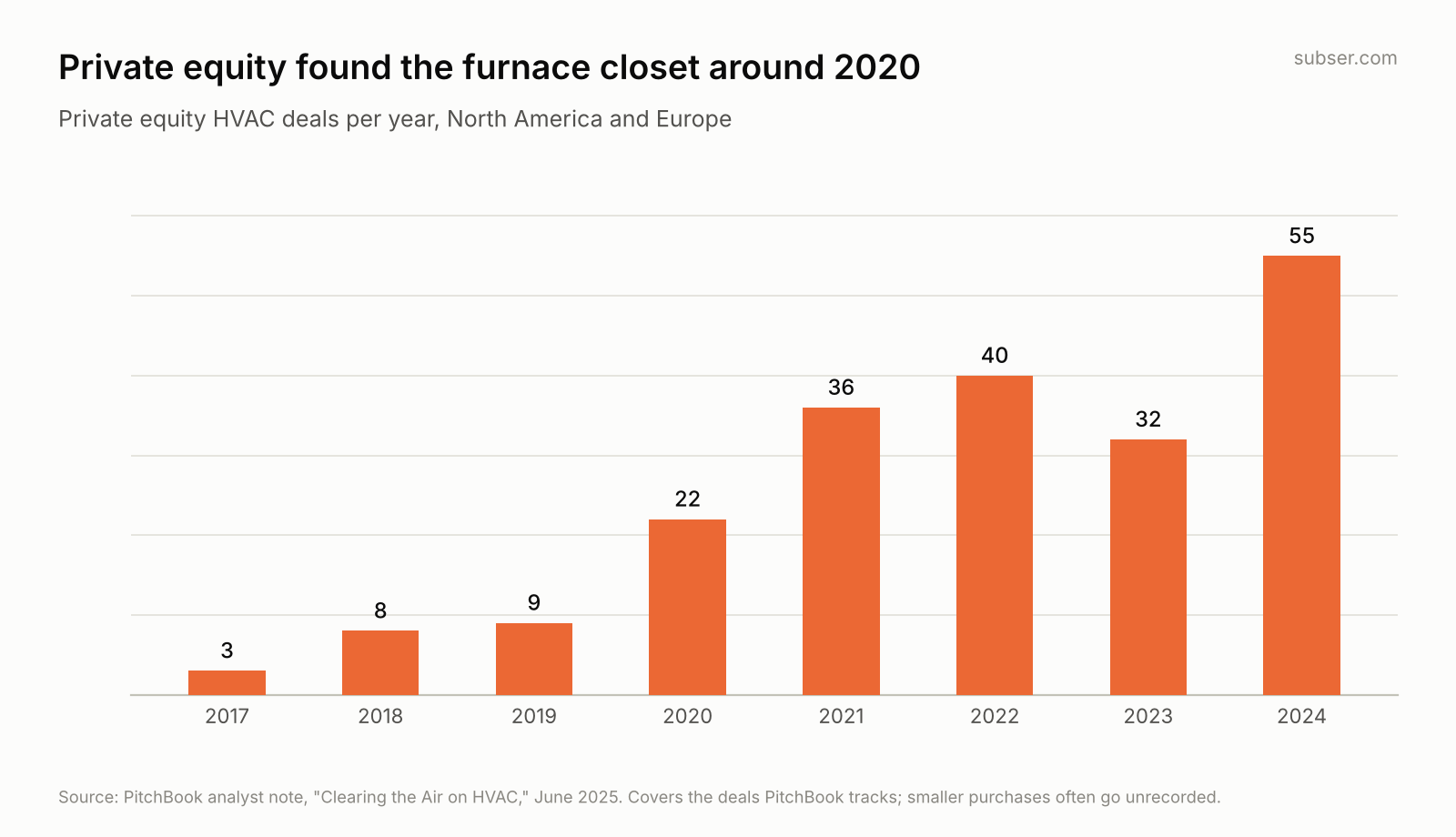
Three deals in 2017. Fifty-five in 2024. The same note counted 466 private equity deals across all specialty construction categories in 2024, up from 335 two years earlier.
The big names have gotten very big. Apex Service Partners, backed by Alpine Investors, says it has 75 brands in 46 states, more than 13,000 employees, and more than $3 billion in revenue. Redwood Services reports 19 companies and more than $500 million. Sila Services, which Goldman Sachs' private equity arm agreed to buy in November 2024, has more than 30 brands.
Washington is on the map. Besides the two Champions deals, there is Mainstream Electric, Heating, Cooling & Plumbing in Spokane Valley, bought by Texas-based Radiant in January 2022. And there is SEER Group, headquartered in Seattle and backed by Genstar Capital, which by April 2024 had made 37 acquisitions since 2018, nine of them in Western Washington.
Now the other side of the ledger, because it matters. There are more than 110,000 heating and air conditioning contractors in the United States, according to IBISWorld. In 2023 the CEO of Wrench Group, one of the large platforms, estimated that private equity held about $10 billion of a $130 billion HVAC market and that 80% or more was still mom-and-pop. He has an interest in making the runway sound long. Even so, the picture is clear enough: a few hundred tracked deals a year, set against more than a hundred thousand contractors in HVAC alone.
Investors haven't taken over home services. They have built a small number of very large, very well-run competitors, and one of them may be in your zip code.
What they're paying for
This is the part I find most useful to understand, even if you never intend to sell.
A small HVAC business sold through a broker goes for a median of about 2.6 times what it earns its owner in a year. That's from BizBuySell's sales data for 2021 through 2025, as compiled by an M&A advisory firm.
HVAC services deals in the investment bank Capstone Partners' data averaged 9.5 times EBITDA from 2024 through mid-2026. In the frothier stretch from 2021 to 2023, the average was 13.3 times. The Champions deal, if the reported price and the reported $140 million in earnings are right, works out to about 18 times.
Put those next to each other. Say a shop throws off $400,000 a year for its owner. On its own, at 2.6 times, it's worth around a million dollars. Tucked inside a platform valued at 9.5 times, those same earnings are "worth" $3.8 million. At 18 times, $7.2 million. That's my arithmetic, it's simplified (owner earnings and EBITDA aren't measured the same way), and real deals have a hundred wrinkles. But the gap is the whole business model. Buy earnings at one price, bundle them, and sell the bundle at a much higher one.
Here is the detail that should interest an independent. After the purchase, the buyer almost always keeps the name. Keeps the trucks, the phone number, often the former owner's face in the ads. In Idaho, a heating company launched commercials featuring its founder in September 2025, four years after an ownership change, and local outlet BoiseDev noted that he didn't mention the current out-of-state owner.
Think about what that tells you. The single most valuable thing a billion-dollar firm acquires in these deals is twenty years of a local family showing up when they said they would. They can supply the call center, the software, and the marketing budget themselves. The reputation is the part they can't build, so they buy it.
You already own one of those.
What happens afterward
I looked for solid evidence on whether service gets better or worse after a buyout. There is less of it than either side of the argument would like.
On the critical side: that same Idaho company, Right Now Heating & Air, whose owner BoiseDev identifies as Tampa-based Apex West Region Holdco, came under investigation by the state Attorney General in April 2025. It ended that December with an assurance of voluntary compliance covering advertising and estimates the Attorney General alleged were misleading. Right Now denied the allegations, admitted no violation, and paid $6,500 toward the state's investigation costs. BoiseDev found 33 complaints to the Attorney General since 2019, 23 of them after the 2021 sale. That sounds damning until you notice the post-sale period is also the longer one. It's suggestive, not proof.
One independent owner told the trade publication ACHR News that roll-ups work toward an exit in three to five years, and the article describes pricing and dispatch being standardized along the way. That is opinion from a competitor, though informed opinion.
On the positive side: Alpine Investors says technicians at its companies see about a 20% raise in the first year through wages, bonuses, and commissions. That's the investor's own claim, and commissions are doing some of the work in that sentence. The Journal described a Tucson company that grew from about $30 million to about $70 million in revenue after joining a platform. Platforms get national pricing from suppliers and can afford training programs a ten-person shop can't.
What I could not find: a single academic study of prices, wages, or quality at private-equity-owned home service companies. Nor any enforcement action that cites private equity ownership as the problem. For perspective, a 2012 Washington Attorney General case against a Sumner HVAC company involved a business with no investor ties mentioned at all. The upsell is older than the roll-up.
One more data point for anyone tempted to think of these firms as unstoppable. Air Pros, a roll-up whose business units included CM Heating & Cooling in Washington, filed for Chapter 11 in March 2025 owing about $250 million to secured lenders. Its filing pointed to its debt load and its failure to fully integrate the companies it had bought. Buying a string of businesses is easy if you have the money. Running them as one is hard.
The bar moved, and it doesn't matter who moved it
My original theory for this post was that consolidation raises what homeowners expect. A platform company has a staffed phone line, text updates, online booking, and financing, so the four-person shop down the road gets measured against that.
I'm less sure of the cause than when I started. The surveys on homeowner expectations mostly come from companies that sell software or services to contractors, and none of them tie expectations to private equity. It's at least as likely that Amazon and Uber taught people what "I'll be there between noon and four" should feel like.
But look at what the surveys say, with the caveat about who paid for them.
Housecall Pro surveyed 1,040 homeowners in late 2025. Eighty percent said online booking factors into who they hire. Fifty-nine percent expect text updates. Sixty-eight percent expect photo or video proof of the work.
Moneypenny, an answering service, surveyed 2,000 consumers and found 83% go with the first business to respond.
And then one that cuts the other way. A Roofing Contractor survey found that only 2% of homeowners expect a contractor to show up the same day. Fifty-four percent expect one to two days.
Read together, those say something specific. People aren't asking the small shop to be instant. They're asking it to answer, to say when, to say if that changes, and to show what was done. None of that requires a call center in another state.
If you're not selling
About half of employer-business owners in the US were 55 or older in the Census Bureau's 2018 data. In Washington, a Project Equity study found baby boomers own close to half of the state's privately held businesses. A lot of trade business owners are going to face the sell-or-don't question in the next decade whether they want to or not. One Florida HVAC owner told the Journal he had received more than a hundred buyout offers since 2020.
If you're going to sell someday, everything above is an argument for getting your books and your job records in order now, because documented earnings and documented repeat customers are what a buyer pays a multiple on.
If you're not, here is what I'd take from the last five years of deal-making.
The roll-ups have an advantage in everything that scales: ad budgets, purchasing, software, a person who answers the phone at 7 p.m. You won't out-spend them on any of it.
They have a disadvantage in everything that doesn't scale. The owner who actually shows up to look at the job. The tech who has been in that house before. A price that isn't set by a regional playbook. Pay that doesn't hinge on selling a new system to someone who called about a noise.
The trouble is that the second list is invisible. A homeowner comparing two vans in a search result can't see any of it. They see stars, a response time, and whether somebody texted back.
So the work for an independent is to make the invisible stuff legible. Answer fast, even if the answer is "Thursday." Send the text when you're running behind. Take the photos. Keep a record of what you did at each address, in a form you own and can show. Those are the cheap parts of what the platforms do, and they're the parts homeowners say they notice.
Investors are reportedly paying around eighteen times earnings for a collection of local reputations. If you've got one, write it down somewhere, and make sure the copy is yours.
That's the bet we're making with Subser: that the independent operator should own their own operating record. If you want to see what your public record looks like today, your state license listing is already in our directory, and claiming it is free.
Sources
Deal counts come from different trackers with different scopes and should not be added together. I could not access the original Wall Street Journal article behind its paywall; its figures are cited as reported in the summaries linked below.
- Blackstone, "Blackstone Announces Agreement to Acquire Champions Group," February 17, 2026
- TheStreet via Yahoo Finance on the reported Champions price
- Orange County Business Journal on the Seatown acquisition
- Champions Group release on Bee's Plumbing, June 2025
- Spokane Journal of Business on Mainstream Electric
- Genstar Capital, SEER Group and Contracting Business on SEER Group's acquisitions, April 2024
- PitchBook analyst note, "Clearing the Air on HVAC," June 2025
- American Investment Council summary of The Wall Street Journal's October 2024 reporting (industry lobby)
- Apollo release on Apex Service Partners, May 2026
- Redwood Services release, May 2025
- Morgan Stanley release on Sila Services
- Axial on IBISWorld's contractor count
- DAK Group / ACHR News, April 2023 (sell-side adviser)
- Capstone Partners, HVAC Services M&A Update, July 2026 (sell-side adviser)
- CT Acquisitions, HVAC business valuation guide (M&A adviser; small-business multiple from BizBuySell data)
- BoiseDev on the Right Now Heating & Air agreement, December 2025
- ACHR News, "Why Some HVAC Contractors Are Rejecting Private Equity Offers," August 2026
- Washington Attorney General on the 2012 Sumner HVAC case
- Chapter11Cases on the Air Pros USA filing
- Housecall Pro homeowner survey, October 2025 (software vendor)
- Contracting Business on the Moneypenny survey, May 2026 (answering service)
- Roofing Contractor homeowner survey, February 2024
- US Census Bureau, business owner ages, Annual Business Survey
- Project Equity, Washington business ownership study