Per-Seat Pricing Is a Tax on Hiring
We priced out contractor software for teams of 1 to 15 using the vendors' own pricing pages. On one popular product, the second login costs $110 a month and the sixth costs $140.
Disclosure before anything else: I run a company that sells software to contractors, and we charge a flat price. So I have an obvious stake in what follows. Every price below comes from a vendor's public pricing page as it read on October 7, 2026. The links are at the bottom. Check my math, and if I got something wrong, tell me and I'll fix it.
Most field service software charges by the user. The pitch is that this is fair: a small shop pays a little, a big shop pays a lot. And for exactly one size of shop, it works out that way.
That size is one.
What the second login costs
Take a solo operator who has been running jobs out of a notes app and finally signs up for real software. Then business is good and they hire a helper. The helper needs a login, because the whole point of the software is that the person on site can see the job, check off the list, and take the photos.
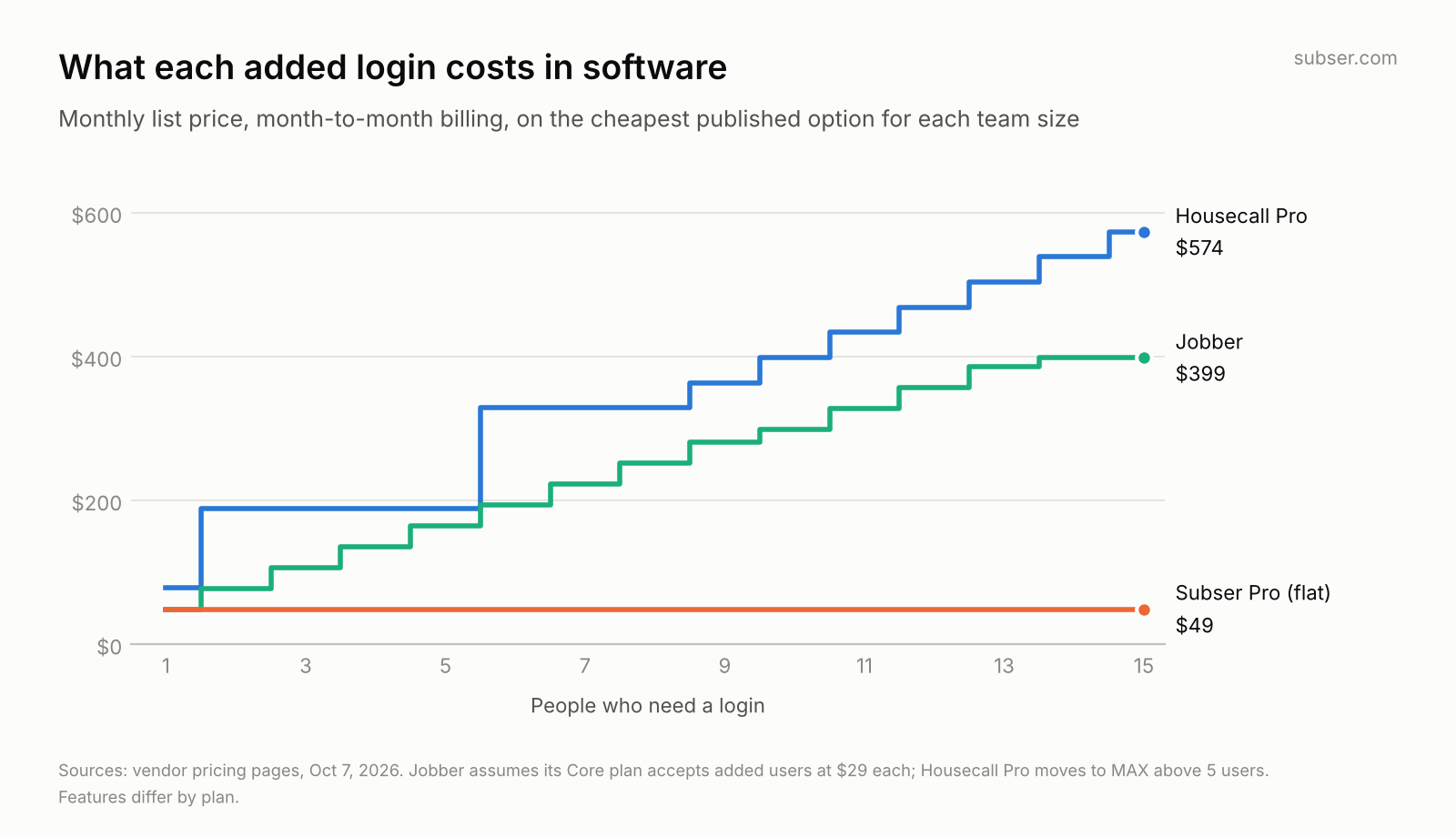
On Housecall Pro, the one-user Basic plan is $79 a month. The pricing page shows no price for adding a user to Basic. The next plan up, Essentials, includes five users and costs $189. So login number two costs $110 a month. That's $1,320 a year.
Logins three, four, and five are free. Then the sixth person arrives. Essentials stops at five, and the next plan, MAX, is $329 with eight users included. Login number six costs $140 a month.
After that it settles down. Each user past eight is $35.
So the price doesn't rise smoothly with the size of the business. It jumps twice, at two people and at six, and those happen to be the two moments a small contractor is most stretched: the first hire, and the point where the owner can no longer personally be on every job.
Jobber is gentler, with a catch
Jobber's entry plan, Core, is $49 a month for one user. The pricing page says users can be added for $29 a month each.
I'll be upfront about an ambiguity. The page describes Core as a one-user plan and also shows a "contact sales" option for teams, so I can't tell from the outside whether a five-person crew can really sit on Core at $29 a head. I've assumed they can, because that's the reading most favorable to Jobber, and I'd rather be wrong in that direction.
On that reading, Jobber is the mildest per-user pricing of the bunch. Every hire costs $29 a month until you reach the ten-user tier.
The catch is what Core leaves out. QuickBooks sync, automated reminders, and time tracking start on the next plan, Connect. Connect is $139 for one user, $199 for up to five, $299 for up to ten. A two-person shop that wants its invoices to land in QuickBooks is paying $168, not $78.
So on Jobber the head count isn't the only thing that moves the bill. Needing a feature moves it too, and the pricing page presents the two together in a way that makes them hard to pull apart. I'd gently suggest somebody decided to do it that way.
The whole staircase
Monthly list price at each team size, month-to-month billing.
| People with a login | Housecall Pro | Jobber, cheapest plan | Jobber with QuickBooks sync |
|---|---|---|---|
| 1 | $79 | $49 | $139 |
| 2 | $189 | $78 | $168 |
| 3 | $189 | $107 | $197 |
| 5 | $189 | $165 | $199 |
| 6 | $329 | $194 | $228 |
| 8 | $329 | $252 | $286 |
| 10 | $399 | $299 | $299 |
| 15 | $574 | $399 | $399 |
Both companies discount for annual billing. Jobber's one-user Core drops to $29 a month if you pay for the year up front, and its five-user Connect tier drops to $149. Housecall Pro's Basic goes to $59 and Essentials to $149. I used month-to-month prices because a shop that just made its first hire is usually not in a mood to prepay a year of anything.
And the plans are not the same product at each step. Housecall Pro's Essentials adds GPS tracking, flat-rate pricing, and QuickBooks sync along with the extra seats. You're paying for features and for people at once.
Now run the yearly numbers for a ten-person shop. Housecall Pro: $4,788. Jobber: $3,588. A flat $49 plan: $588. The gap is $3,000 to $4,200 a year, which is about what a decent used trailer costs.
Then there are the ones who won't tell you
Workiz lists three plans on its pricing page. All three say "Request pricing." Its billing FAQ does confirm the structure, though: plans include a set number of seats, they're sold on annual contracts, and removing a user does not reduce your seat count or your price during the contract term.
Read that last part again as a business owner in a seasonal trade. You staff up to six in May. In October you are back to three. You keep paying for six until renewal.
ServiceTitan publishes no prices either. Its pricing page describes per-technician plans. What it charges is something you find out on a sales call. There is one public clue. In its annual report, ServiceTitan says it counts a business as an "Active Customer" only above $10,000 in annualized billings, and that those roughly 10,800 customers made up more than 97% of its billings. Ten thousand dollars a year is $833 a month. That's the floor for counting.
This isn't a knock on ServiceTitan. It builds for large shops and prices like it. It does tell you who the product is for.
How big contractors are
All of this would be a rounding error if the typical contractor had forty employees. The typical contractor doesn't.
More than 1.9 million specialty trade contractors in the US have no employees at all. That is 79% of the establishments in the sector, according to the National Association of Home Builders' reading of Census data, and their average receipts were under $70,000.
Among construction establishments that do have a payroll, 81.2% have between one and nine workers, according to CPWR's analysis of County Business Patterns.
Washington looks about the same. The Small Business Administration's 2025 state profile counts 36,289 construction firms with no employees, 24,577 with one to nineteen, and 2,005 with twenty to 499.
Among remodelers who belong to NAHB, the median firm has five employees.
Five employees plus the owner is six people. That's one more than Housecall Pro's five-user plan holds. The sixth login is the $140 one.
What people do about it
When something is priced per head, people ration it. Nobody finds that surprising at a restaurant.
I went looking for a solid number on how many shops share one login among three people to dodge seat fees, and I didn't find one I'd trust. So I won't quote one. What I can point to is smaller. On Capterra, one Jobber customer who gave the product five stars still noted that they could have five users and the cost went up significantly to add another. Capterra's own summary of Jobber reviews lists the jump between plans among the things holding users back.
Here is the reasoning part, and I'll label it as reasoning. If a login costs money, the owner decides who is "worth" one. The lead tech gets one. The apprentice doesn't. So the apprentice texts photos to the lead, who uploads them at night. The part-time office help uses the owner's password. Now the job history says the owner did everything, the apprentice has no checklist in front of him, and the one thing software is supposed to give you, a record of who did what and when, is wrong from the first day.
Thirty or a hundred dollars a month won't sink anyone. The damage is in the behavior it teaches. It puts a toll on the exact thing a growing shop needs to do, which is get every person on the job looking at the same information.
The case for per-seat pricing
There is a real argument on the other side, and here it is at full strength.
For a solo operator, seat pricing is cheaper. Jobber's Core at $29 a month on annual billing beats our Pro plan at $49. And since 79% of specialty trade businesses have no employees, you could say the "tax" never touches most of the market.
Seat pricing also tracks ability to pay. A fifteen-person shop bills far more than a two-person shop. Under flat pricing, the small shop pays the same as the big one, which means in some sense the small one is subsidizing the big one's support tickets.
And flat pricing always meters something. ServiceM8 gives you unlimited users and charges by the number of jobs instead: $29 a month for 50 jobs, $79 for 150, up to $349 for 1,500 and above. Ours has limits too. Subser's Pro and Business plans are capped at 75 team members, and our two cheapest plans cap the number of jobs per month. No one sells truly unlimited anything. You are only ever choosing what gets counted.
All fair. My answer is that what you count shapes what your customers do.
Count jobs, and the bill grows when the business has more revenue to pay it. Count people, and the bill grows when the business takes on a cost. A new hire is already the most expensive, riskiest thing a small contractor does. They are covering wages, workers' comp, a second set of tools, and three months of that person being slower than they will be. A software surcharge on top of that is pointed in exactly the wrong direction.
What $49 covers
We built Subser after per-seat pricing had become the industry's default, looked at what it does to a growing shop, and decided not to copy it. Pro is $49 a month. Business is $99. Either one covers up to 75 team members, with no per-user fee on any paid plan and no annual contract. There is also a free plan for one person and a $19 Starter plan, both with monthly job limits.
The flat price would be a gimmick if it bought a stripped-down product, so here is what the whole crew gets at $49. Scheduling with day, week, and month calendars. Crew assignments. One-click route optimization. Online booking on your own branded page. Automatic text and email reminders. A live tracking link so the customer can see you're on the way. Estimates built from your price book. A notebook on every job for photos, markup, and a gallery link for the customer. Voice-to-task capture, for when your hands are full. Mobile apps for iPhone and Android that keep working with no signal. Invoicing and card payments through Stripe, including Apple Pay and Google Pay. Customer history. Unlimited jobs.
Now hold that list against the staircase. On Housecall Pro, route optimization is listed on MAX, the $329 plan, and employee GPS tracking starts on the $189 plan. On Jobber, checklists and automated client reminders start on Connect, at $139 for a single user. Those are their pricing pages talking, not me. The pattern in this industry is that the tools a crew uses in the field sit a tier or two above the entry price, and the entry price is for one person.
Then there's the second subscription. A lot of crews run a photo documentation app next to their scheduling software, and the best known is CompanyCam. It's a good product, and it has integrations with both Jobber and Housecall Pro so that job-site photos land on the right job. It is also priced by the user. Its pricing page lists Core at $63 a month for one user, Crew at $129 for three, and Scale at $199 for three, with each additional user at $29. Standardized checklists start on Crew.
Stack them for a five-person crew. Jobber's five-user Connect tier is $199. CompanyCam Crew with two added users is $187. That's $386 a month, or $4,632 a year, for two apps, two logins per person, and an integration holding them together. Every hire after that adds $29 on the CompanyCam side and, past five people, $29 on the Jobber side too.
In Subser, the photos live in the job itself. The tech opens the job, works the tasks, takes before-and-after shots, marks them up with arrows, text, and a blur tool, and sends the customer a gallery link when it's done. On an iPhone Pro they can measure right off the photo. All of it is attached to that customer's record when the invoice goes out, and it keeps working in a basement with no signal. It's one app, one login, and $49 for the crew. CompanyCam still does things we don't, like AI-written job reports, and a company whose business is photo documentation may want them. Most crews need proof the work was done and done right, attached to the job, and they shouldn't have to pay per head twice to get it.
So the per-seat model charges you more than once for growing: for the people, for the features those people need, and again in the second app. We charge for none of it.
One thing we haven't shipped: QuickBooks Online sync. It's on our build list. Jobber and Housecall Pro both include it on their mid-tier plans, and if your bookkeeper won't work without it today, that's a real consideration. I'd rather you hear it from me than find out on day three of a trial.
What I'd ask you to do, whatever you use, is run your own staircase. Write down how many people touch your jobs in July, not how many logins you pay for. Look up what your vendor charges at that number, and at that number plus two. If the answer makes you want to hand out fewer logins, the pricing is steering your business, and you should at least know that it is.
Sources and method
Prices were read from each vendor's public pricing page on October 7, 2026, in US dollars, before tax, promotions, and add-ons. The team-size table assumes every person needs their own login and uses month-to-month billing. For Housecall Pro, the Basic and Essentials plans show no published price for extra users, so two to five people are priced on Essentials and six or more on MAX at $329 plus $35 per user above eight. For Jobber, "cheapest plan" is the lowest of Core plus $29 per added user or a Connect team tier plus $29 per added user; it assumes Core accepts added users, which the pricing page implies but does not make certain. "With QuickBooks sync" is the lowest Connect option. The Jobber plus CompanyCam example uses Jobber's month-to-month price; CompanyCam's page does not say whether its listed plan prices are monthly or annual rates, and quotes its $29 per-user price on annual billing. The cost-per-added-user and annual figures are my arithmetic from those list prices.
- Jobber pricing
- Housecall Pro pricing
- Workiz pricing plans and Workiz Billing FAQ
- ServiceTitan pricing and ServiceTitan annual report for the fiscal year ended January 31, 2026
- ServiceM8 pricing
- CompanyCam pricing, CompanyCam and Jobber integration, and CompanyCam and Housecall Pro integration
- Subser pricing
- NAHB Eye on Housing, "Most Home Builders are Small Businesses"
- CPWR Data Bulletin, April 2026
- SBA Office of Advocacy, 2025 Small Business Profile: Washington
- NAHB, "Median Revenue of NAHB Remodelers Grows 24%," September 28, 2026
- Capterra, Jobber pricing and reviews