
An Autopsy of the One-Star Review
We went looking for what homeowners complain about when they give a contractor one star. The reviews are about how the job was run. The formal complaints are about what got built. Fixing the first kind is cheap.
I started this post with a theory I was fairly proud of. Nobody leaves a one-star review about the grout. They leave it because the contractor showed up two hours late without calling, or the bill came in $900 over the estimate with no warning, or the last three items on the punch list are still not done in March.
Then I went and read the research, and it turns out I was about half right. The other half is more interesting than the theory was, so here's the whole thing.
Reviews come in two flavors
Start with the shape of the data. In 2019 the marketing agency Zion & Zion pulled 146,430 Yelp reviews of 6,376 home service companies and counted the stars.
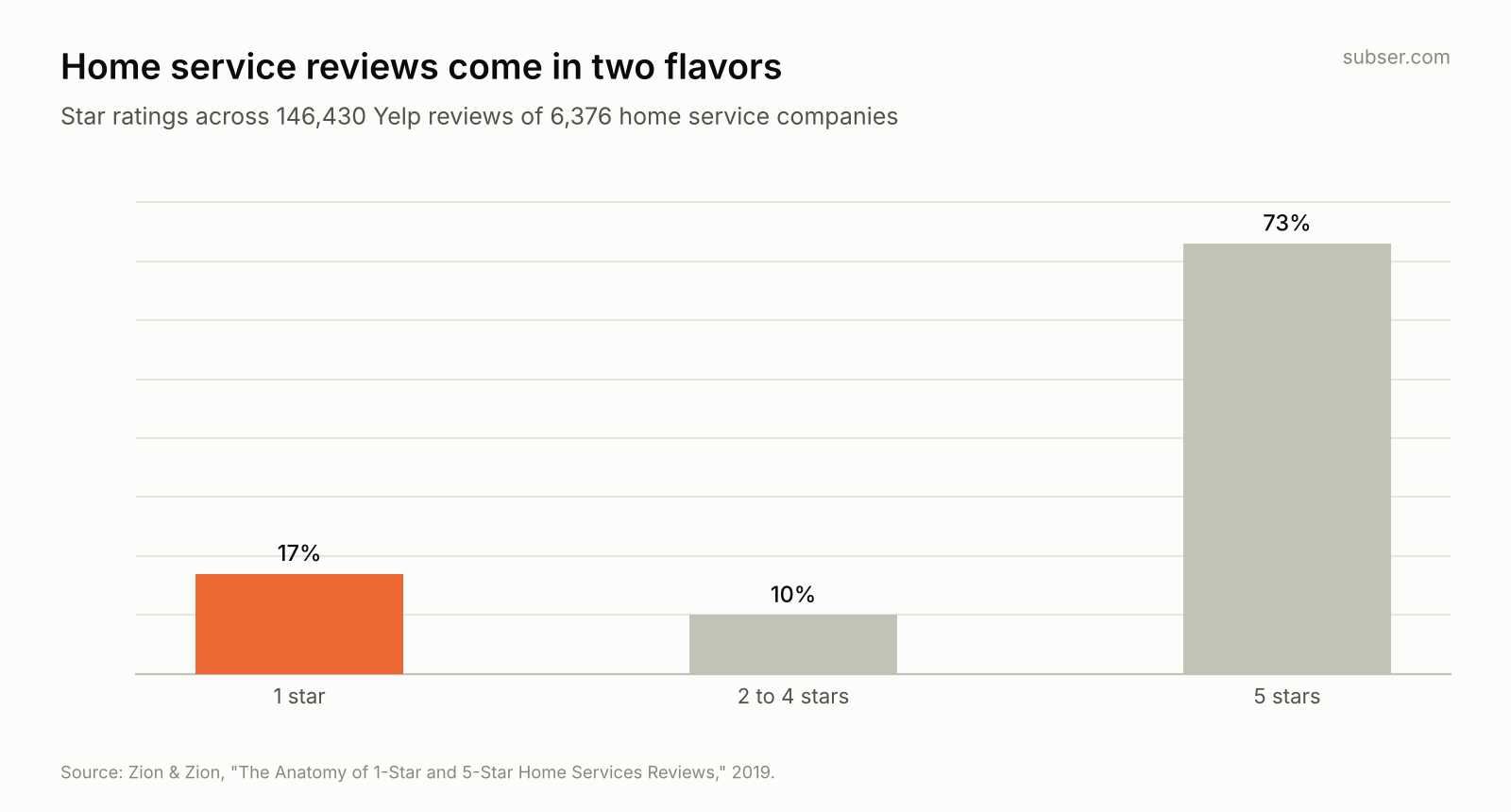
Seventy-three percent were five stars. Seventeen percent were one star. Everything in between, the twos and threes and fours, added up to 10%.
Researchers call this the J-shaped distribution, and it shows up widely in online ratings. A well-known paper on Amazon reviews explained it with two forces. People who expect to like something are the ones who buy it, which piles up the fives. And people with a middling experience mostly don't bother to write anything, which hollows out the middle. Who's left? The delighted and the furious.
For a contractor, this means your rating isn't a grade on your work. It's a count of how many people you thrilled against how many you infuriated. The customers who thought you were fine, the big quiet majority, aren't in the data at all.
That makes the one-star review worth understanding. It's 17% of the reviews and a much bigger share of the damage: in BrightLocal's 2026 survey, 68% of consumers said they'll only use a business with four stars or more.
What the angry reviews say
Zion & Zion read about a thousand of those reviews closely. In the one-star pile, 39% complained about the same thing: the company was late, never arrived, or changed the appointment.
That one finding carries a lot of weight. Four in ten of the worst reviews a home service company gets are about the calendar.
Newer: in October, Whitespark published an analysis of reviews from 1,200 Google Business Profiles across 50 industries, 19 of them home service trades. Communication was the top negative theme, or tied for the top, in all 19. It appeared in 61% of negative reviews for plumbers and for HVAC companies. Pricing was second: 60% for plumbers, 52% for HVAC, 38% for remodelers.
And workmanship? Whitespark reported it for only three trades. Roofing came in at 25%, less than delays at 30%.
Some cautions about that study. Whitespark sells review management software. The themes overlap, so the percentages add up past 100. The article doesn't say how many reviews were coded or exactly how. I'd treat the numbers as a rough ranking. But the ranking matches the Yelp study from seven years earlier, and it matches an older finding from GuildQuality, which surveyed thousands of remodeling customers and found that communication, scheduling, and punch-list problems tracked most closely with unhappy clients.
So far, my theory is looking good.
Where the theory breaks
Then there's the United Kingdom, where Citizens Advice logs formal consumer complaints. Between July 2024 and June 2025 it handled 36,534 complaints about home improvement work. The top category, at 52.8%, was substandard services. Failure or delay in providing the service was 7%. Customer service was 3.5%.
That's the reverse of the review data. And it isn't a one-off. A survey of 500 British homeowners by the insurer Markel found poor or rushed work was the top irritant at 39%, ahead of no-shows at 35% and mid-job price changes at 26%. An older American survey had shoddy work first at 40% and late starts close behind at 36%. The UK consumer group Which? found quality of work was the most common cause of disputes with builders.
So which is it? Do people complain about the work or about the way the job was run?
Both, and it depends on where they're complaining.
A one-star review takes three minutes and costs nothing. It's what people do when they're aggravated. A formal complaint to a consumer agency takes real effort, and people make that effort when they've lost real money, which usually means something was built wrong.
Here's the sentence I'd put on the wall. Reviews are about how the job was run. Formal complaints are about what got built.
The two also feed each other. A homeowner who has been kept informed will forgive a lot. One who has been ignored for two weeks starts inspecting the caulk lines.
There's a finding from Clever Real Estate's 2024 survey of a thousand homeowners that captures this nicely. Thirty-nine percent believed their contractor had cut corners. Thirty-two percent had a contractor fail to show up to start the job. And 70% said they would hire the same contractor again. People can hold a grudge about the details and still come back, if the overall experience felt like someone was in charge.
The reviews read sad, not angry
One more thing from Zion & Zion, and it's my favorite finding in this whole pile. They ran 26,955 one-star home service reviews through IBM's text analysis software to classify the emotional tone.
Anger showed up in 22.7% of them. Sadness showed up in 62.6%.
Software that sorts feelings into buckets is a blunt instrument, and I wouldn't lean hard on the exact figures. But read a few dozen one-star contractor reviews and you'll see what the machine saw. The typical bad review isn't a rant. It's disappointment. They took a day off work. They waited. Nobody came, and nobody called.
Disappointment is cheaper to prevent than anger, because it usually comes down to a gap between what someone was told and what happened. Close the gap, in either direction, and most of it never forms.
Budget surprises: pick your statistic
Pricing was the second-biggest theme in the negative reviews, so it's worth asking how often jobs go over.
Houzz's 2026 Houzz & Home Study drew on more than 20,000 US homeowners. For projects done in 2025, 37% of homeowners went over budget, 35% hit it, 3% came in under, and 25% never set a budget at all. Among people who had a budget, that's about half going over. The most common reason, cited by 52%, was that products or services cost more than expected.
Clever's survey found something very different: 78% said they went over budget on their last project, and 35% were over by $10,000 or more. Oddly, the same survey puts the figure at 53% for people who used a contractor.
Thirty-seven percent, fifty-three, or seventy-eight. That's quite a spread, and I can't fully reconcile it. Different samples, different definitions of "budget," different years. What I take from the gap is that the homeowner's budget is often a number in their head that the contractor never heard. If a quarter of Houzz's respondents had no budget at all, then "over budget" frequently means "more than I vaguely hoped."
You can't control that number. You can control whether every change to your number gets written down and approved before the work happens. A change order sent by text at the moment the rot is discovered is a non-event. The same $900 appearing for the first time on the final invoice is a one-star review.
Should you apologize? The research is odd
Here's where it gets counterintuitive.
Economists working with Uber ran an experiment on about 1.5 million riders who'd had a late trip. They tested different kinds of apology, with and without a coupon toward a future ride. The coupon was the most effective apology. In some cases an apology was worse than saying nothing.
A separate field experiment with a food delivery company found that proactively apologizing for a minor delay reduced reordering. The researchers' explanation: by announcing that it had failed, the company made customers more likely to remember the order as a failure.
Before you conclude that you should never say sorry, look at what kind of failure was involved. A delivery arriving eight minutes late is easy to shrug off until someone labels it a failure. A contractor who doesn't show up for a 9 a.m. appointment is the opposite of invisible. The homeowner is standing at the window.
The research supports a fairly simple rule. If the customer has already noticed, or is about to, tell them first, and tell them what you're doing about it. If they haven't noticed and it doesn't affect them, fix it quietly. And when you've cost someone real time or money, do something concrete about it, because that's what the coupon was doing in the Uber study.
There's also the idea, popular in business books, that a well-handled mistake leaves customers happier than no mistake at all. A meta-analysis found it holds for satisfaction but not for whether people say they'll come back or what they tell their friends. Handling a problem well gets you back to even. It doesn't put you ahead of having had no problem.
What happens after the review
When hotels started replying to their reviews on TripAdvisor, their ratings rose by an average of 0.12 stars and they got 12% more reviews, according to a study in Marketing Science. The negative reviews that did come in afterward were rarer and longer, as if people thought twice once they knew the owner was reading.
BrightLocal's survey found 89% of consumers expect business owners to respond to reviews. Half said they're put off by replies that are obviously templated.
And there's such a thing as too perfect. Northwestern's Spiegel Research Center found that purchase likelihood peaks when a product's rating is between 4.2 and 4.5 stars, then drops as it approaches 5.0. That was online retail, not home services, so translate with care. But the instinct behind it is familiar: a flawless score looks curated. A 4.7 with a couple of complaints and a calm, specific reply under each one looks like a real business.
The cheap fixes
Workmanship is expensive to improve. It takes training, time, and better people. I'm not going to pretend a blog post helps with that, and the complaint data says it matters most when real money is lost.
The stuff that drives one-star reviews is different. It's nearly free.
Confirm the appointment the day before. If you're going to be late, say so before you're late, with a new time. One call-tracking company's data suggests about a quarter of calls to home service businesses go unanswered and almost nobody leaves a voicemail, so if you can't pick up, text back within the hour. Put every price change in writing before the work, even if it's one line. Finish the punch list, or say plainly when you will. Reply to every review in your own words.
None of that requires being a better plumber. It requires that what the customer was told and what the customer experienced are the same thing, and that there's a record of both.
That record is most of what Subser does: the appointment, the checklist, the photos, the approved changes, all attached to the job. We built it that way because the research kept pointing at the same culprit, and it wasn't the grout.
Sources
Several of these studies come from companies that sell review, marketing, or call-tracking products; I've flagged them. Where a study didn't publish its sample size or method, I've said so in the text.
- Zion & Zion, "The Anatomy of 1-Star and 5-Star Home Services Reviews," 2019 (marketing agency)
- Zion & Zion, "Angry or Just Sad?" IBM Watson analysis of one-star reviews, 2018
- Hu, Pavlou and Zhang on the J-shaped distribution of online reviews, Communications of the ACM
- BrightLocal Local Consumer Review Survey 2026 (local SEO vendor; n=1,002)
- Whitespark, "Why Customers Leave Good and Bad Google Reviews," October 2026 (review software vendor)
- Journal of Light Construction on GuildQuality's customer survey findings
- Citizens Advice, home improvement complaints, August 2025
- Insight DIY on the Markel Direct homeowner survey, July 2026 (insurer)
- Journal of Light Construction on the Kimberly-Clark Professional survey, 2006
- Building magazine on Which? research into builder disputes
- Clever Real Estate, home renovation trends survey, 2024
- Houzz, 2026 Houzz & Home Study findings
- Halperin, Ho, List and Muir, "Toward an Understanding of the Economics of Apologies," NBER working paper 25676
- Marketing Science Institute on Jenkins, Fombelle and Steffel's apology research
- Oracle on the service recovery paradox and the de Matos, Henrique and Rossi meta-analysis
- INFORMS on Proserpio and Zervas, review responses and hotel ratings
- Spiegel Research Center, Northwestern University, star ratings and purchase likelihood
- Invoca on missed calls in home services, May 2024 (call-tracking vendor; method not published)