Angi Moved Into ChatGPT. Here's What the Robot Knows About Your Business.
Angi, Thumbtack and Yelp are now wired into AI assistants. We looked at the studies on where those assistants get their information about local contractors, and built a twenty-minute audit you can run on your own business.
On March 4 of this year, Angi launched an app inside ChatGPT. A homeowner can now type something like "my water heater is leaking from the bottom, what do I do" and, along with the advice, get a short list of local pros. Tap one and you're handed to Angi's own AI helper to request a quote.
Six months later, on September 16, Angi announced it was among the first brands in OpenAI's "Sponsored Agents" pilot. That one is an ad product: a labeled, branded Angi agent can appear in conversations about home projects and steer the person into Angi's request flow.
Angi was not alone. Thumbtack announced its ChatGPT partnership in October 2025 and added an integration with Anthropic's Claude in April. Yelp signed a licensing deal with OpenAI in July, under which Yelp's reviews, photos, and business details will surface in ChatGPT answers. Angi connected to Google's Gemini in August and has an Amazon Alexa integration in the works.
For twenty years, the company standing between a homeowner and a contractor was a website. You knew where it was. You could see your listing on it. Now the middleman is moving inside a conversation, and when a homeowner asks an AI who to call, the answer doesn't come with ten blue links. It comes with a short list of names.
You'd want to know how it picks them. Mostly, nobody outside those companies can tell you. Angi's announcement gives no ranking criteria. But there's a fair amount of research on where these assistants get their facts about local businesses, and you can check your own standing in about twenty minutes. Both are below.
First, how big is this really
Smaller than the headlines and bigger than you'd like.
On the "smaller" side: SE Ranking studied traffic to more than 100,000 websites and found AI assistants sent 0.32% of visits in early 2026. Organic search sent 42.75%. That's search engines delivering about 134 times as many visitors. Gartner predicted in 2024 that traditional search volume would fall 25% by 2026. It's 2026, and there's no sign of that in the traffic data.
On the "bigger" side: Pew Research found that 49% of US adults now use AI chatbots, up from 33% in 2024. And BrightLocal, which surveys about a thousand American adults each year on how they pick local businesses, reported that 45% had used generative AI for local business recommendations, up from 6% the year before.
I'd handle that last number with tongs. A jump from 6 to 45 in twelve months, in self-reported survey data from a company that sells local marketing tools, deserves some doubt. But even if the truth is half that, the direction is not in question. In the same survey, the share of people using Google to read reviews fell from 83% to 71%.
Both sides have a measurement problem, by the way. Traffic studies count clicks. If someone asks an assistant for a plumber, gets a name and a phone number, and calls, no website ever records a visit.
The funnel gets narrow
Here is the number from all this research that I keep coming back to.
SOCi, a marketing software company, looked at about 350,000 business locations belonging to 2,751 multi-location brands and checked how often each got recommended on different platforms.
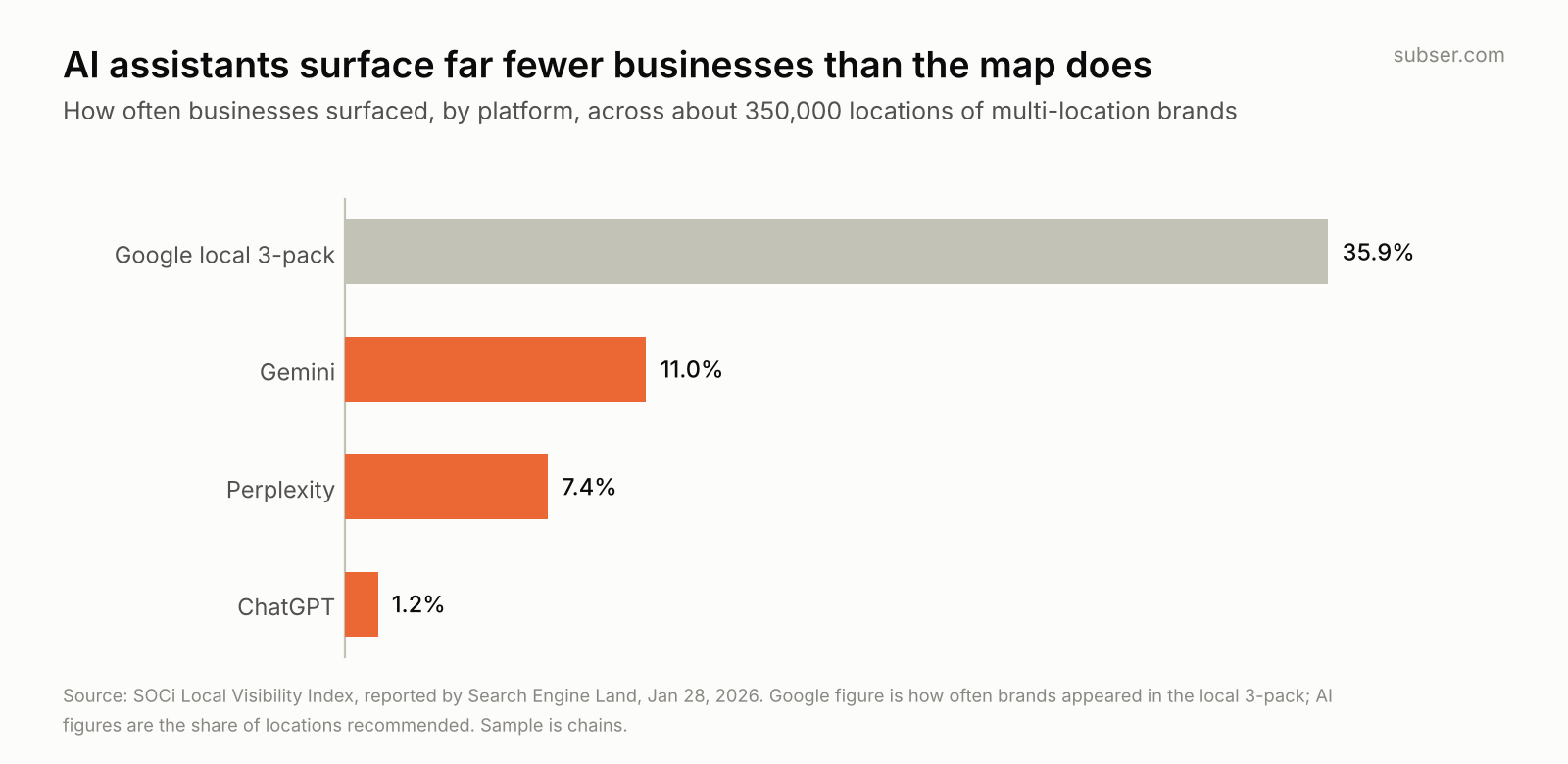
Brands in the sample appeared in Google's local results, the map with three businesses under it, 35.9% of the time. Gemini recommended 11% of the locations. Perplexity, 7.4%. ChatGPT recommended 1.2%. The Google figure and the AI figures aren't measured quite the same way, so treat this as a rough comparison.
The sample is chains, not independent contractors, so don't read the exact figures onto your own business. Read the shape. A search results page is a long list, and being seventh still gets you some calls. An AI answer is a short list. You're one of the few names in it or you aren't there at all.
Where the robot gets its information
Four studies, all from companies with something to sell, all pointing in a similar direction.
BrightLocal analyzed about 1.97 million citations across ChatGPT, Google's AI Overviews, and Google's AI Mode for more than 1,300 business locations. Google Business Profile was the single largest source, at 28.6% of all citations. For plumbers specifically it was 54%. Yelp was second for plumbers at 13.8%, and Yelp showed up in 80% of ChatGPT's local answers.
Foundation Marketing and AirOps looked at more than 28 million AI responses across four AI platforms in late 2025, comparing six local directories and leaving Google Maps out of the count. Yelp led overall with about 513,000 citations, followed by the Better Business Bureau at about 150,000 and Angi at about 146,000. On ChatGPT alone, the order flipped: BBB first, Angi second, Yelp third. That doesn't square neatly with BrightLocal's finding about Yelp, which is what happens when two studies count citations in different ways.
Yext examined 6.8 million citations and found 44% pointed to businesses' own websites, 42% to listings, and 8% to reviews and social media.
And SOCi found that business details on ChatGPT and Perplexity were accurate about 68% of the time. Gemini, which has Google's own business data to lean on, scored 100%.
So between them, the robots know what your Google Business Profile says (Google's own AI leans on it hardest), what Yelp says, what the BBB says, what Angi says, and what your own website says. Outside Google, they get those details right about two-thirds of the time.
There's a twist in the Yelp part. Yelp filters reviews, and only the ones it marks "recommended" count toward your star rating. The trade newsletter HomePros described one contractor with 98 Yelp reviews, of which Yelp recommends 11, for a 3.6-star rating. The same contractor has 4.9 stars across 1,307 Google reviews. Whether ChatGPT will show Yelp's filtered rating or something else hasn't been disclosed. Yelp says that's up to OpenAI.
It also makes things up
In January, a family-run pizza place in Wentzville, Missouri had to ask customers not to rely on AI search results for its prices. Google's AI Overview had invented specials the restaurant never offered.
The same month, CNN reported on tourists turning up in a small Tasmanian town looking for the "Weldborough Hot Springs." There are no hot springs in Weldborough. A tour company's AI-written blog post had described them. The local hotel was fielding about five calls a day.
OpenAI's own help page says ChatGPT's citations can be outdated or wrong.
For a contractor, the realistic version of this is less funny. Old hours. A service you stopped offering in 2022. A phone number from two office moves ago. A service area that leaves out the city where you do half your work. Any of those in an AI answer costs you a call you'll never know you missed.
The twenty-minute audit
Set a timer. You need a phone or a laptop and your contractor registration number.
Minutes 1 to 5: ask the robots. Open ChatGPT, Google's AI Mode, and Gemini. Ask each one two questions. First, the question a customer would ask: "Who's a good [your trade] in [your city]?" Second: "Tell me about [your business name] in [your city]." Write down whether you appear in the first answer and every wrong fact in the second. Hours, phone, services, service area, years in business.
Minutes 6 to 10: fix your Google Business Profile. This is the biggest single source in the research, and it's free. Check the hours, the phone number, the service area, and the list of services. Add photos from this year. Google's own documentation for its AI features says there's no special markup or AI-specific file required; it asks that your Business Profile be kept current and that any structured data on your site match the text a visitor can see.
Minutes 11 to 14: Yelp and the BBB. Claim both listings if you haven't. On Yelp, scroll to the bottom of your reviews and look at the ones "not currently recommended," so you know which reviews Yelp is counting. On the BBB, make sure the listing exists and the details are right. You don't need to pay for accreditation to have an accurate listing.
Minutes 15 to 18: your own website. Three checks. Is your contractor registration number on the page in plain text? Washington requires it in all advertising, including online, and it's the one fact about your business anyone can verify against a state database. Are your services and the cities you serve written out in ordinary sentences, not buried in images? And is your phone number the same everywhere it appears?
Minutes 19 to 20: your state record. Look yourself up on L&I's Verify tool or in the Subser directory. Confirm the status is active and the address is current. It's the public record of whether you're allowed to work, and you should know what it says.
Put the results in a note. Run it again in three months.
What to skip
A cottage industry has appeared to sell contractors "AI optimization." Some of it is reasonable. Some of it is selling answers nobody has.
You'll be told to add a file called llms.txt to your website. SE Ranking looked at about 300,000 domains and found no measurable effect on how often AI assistants cited them. Another test examined roughly 18,000 AI citations and found six that pointed to an llms.txt file. A Google search advocate compared pages built only for AI to the keywords meta tag, a reference that should make anyone who built websites in 2003 wince.
You'll be told that structured data markup is the secret. Microsoft has said publicly that Bing and Copilot use it. Neither OpenAI nor Google has confirmed anything similar for their assistants. It doesn't hurt. It's not the first thing to fix.
You'll be told exactly how ChatGPT ranks local businesses. Nobody selling you that knows. OpenAI says it uses third-party providers for nearby listings and "sometimes partners with" other search providers. That's the extent of what's public.
The part that should bother you
Angi's revenue was about $1.03 billion in 2025, down 13% from the year before. The average number of pros active on its platform each month fell from 143,000 to 111,000 between the fourth quarter of 2024 and the fourth quarter of 2025, a 23% drop. In 2023, the Federal Trade Commission finalized a consent order with HomeAdvisor, a company affiliated with Angi, settling the agency's allegations that it made misleading claims about the quality and source of the leads it sold to contractors. The order required up to $7.2 million in redress, and the agency later sent more than 110,000 refund checks.
I bring this up for a reason other than piling on. Angi's business model is selling contractors access to homeowners, per lead. That model had been shrinking. An AI assistant that hundreds of millions of people already talk to is a new front door, and Angi was among the first to pay for a spot beside it.
If your business is known to the AI mainly through a lead marketplace, then the marketplace is your record. Your reviews live there. Your response time lives there. Your completed-job count lives there. Stop paying and that history stays behind.
The research above points at a different approach. Several of the sources these assistants lean on are ones you control or can at least correct: your Google profile, your listings, your own site. Add your state registration, which anyone can check. Those are the places to build a record, because nobody can turn them off when your card declines.
The Sponsored Agents pilot tells you where this is headed. There will be a paid lane into the AI's answer, and the companies with the budgets will be in it. The unpaid lane is being the business whose public facts are complete, consistent, and checkable. I wouldn't call that a guarantee. But it's the lane an independent can afford, and right now most of your competitors haven't looked.
Sources
Most research on AI and local search is published by companies that sell marketing software or services. I've noted that where it applies. Sample sizes and methods are as the publishers reported them.
- Angi, "Angi Launches Angi App in ChatGPT," March 4, 2026
- Angi, Sponsored Agents pilot announcement, September 16, 2026
- Angi, Gemini announcement, August 2026
- Thumbtack and OpenAI announcement, October 2025
- Thumbtack in Claude, April 2026
- Axios on the Yelp and OpenAI deal, July 23, 2026
- HomePros on how Yelp displays reviews
- SE Ranking AI traffic study, June 2026 (SEO software vendor)
- Gartner search volume forecast, February 2024
- Pew Research Center, chatbot use among US adults, June 2026
- BrightLocal Local Consumer Review Survey 2026 (local SEO vendor; n=1,002)
- BrightLocal, AI directory sources study, August 2026
- PPC Land on the Foundation Marketing / AirOps citation study (agency research)
- Yext AI citations study, October 2025 (listings vendor)
- Search Engine Land on SOCi's Local Visibility Index, January 2026
- OpenAI help center, ChatGPT search
- Google Search Central, AI features and your website
- Search Engine Journal on llms.txt and AI citations
- Search Engine Land on LLM-only pages and the Peec AI test
- Search Engine Land on Bing, Copilot and schema
- WNDU on the Stefanina's AI specials, January 2026
- CNN via KTVZ on the Tasmania hot springs, January 2026
- L&I, contractor registration and advertising requirements
- Angi fourth quarter 2025 earnings release
- FTC, HomeAdvisor final order and FTC refunds announcement